> For the complete documentation index, see [llms.txt](https://participanthelp.dscout.com/llms.txt). Markdown versions of documentation pages are available by appending `.md` to page URLs; this page is available as [Markdown](https://participanthelp.dscout.com/getting-paid/getting-paid-via-paypal/how-to-add-your-paypal-email-address-to-your-dscout-account.md).
# How to add your PayPal email address to your Dscout account
If the email address you use for Dscout is different from your PayPal email address, you can easily add your Dscout email address as an alias on your PayPal account (read more [here](/getting-paid/getting-paid-via-paypal/adding-an-alias-to-your-paypal.md)) or you can add your PayPal email address in your Dscout profile. Read more below.
**Pro tip**: Please double check the spelling of your PayPal email address before saving!
## Adding your PayPal email address on Android
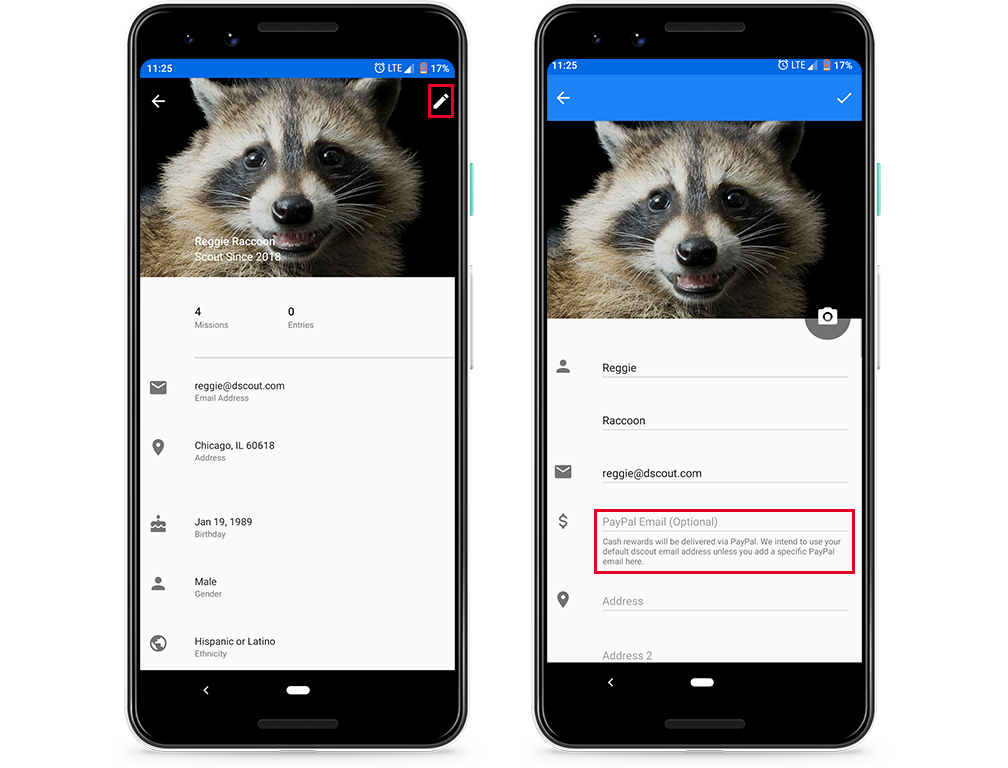
To add your PayPal email address in your Dscout profile on an Android device, follow the directions below:
1. Tap on the **Triple Horizontal Lines icon ☰** on the top-top left corner of your screen to access your side menu.
2. Tap the **View Profile button** beneath your profile picture on your side menu.
3. Tap on the **Pencil icon** on the top right corner of your screen. This will allow you to edit your profile.
4. Add your PayPal email address in the field **PayPal Email** next to the **$ icon**.
5. Tap the **Checkmark icon** on the top-right corner of your screen. This will save your information and all payments will be sent to your PayPal email address as opposed to the email address you use for Dscout.
 ## Adding your PayPal email address on iOS
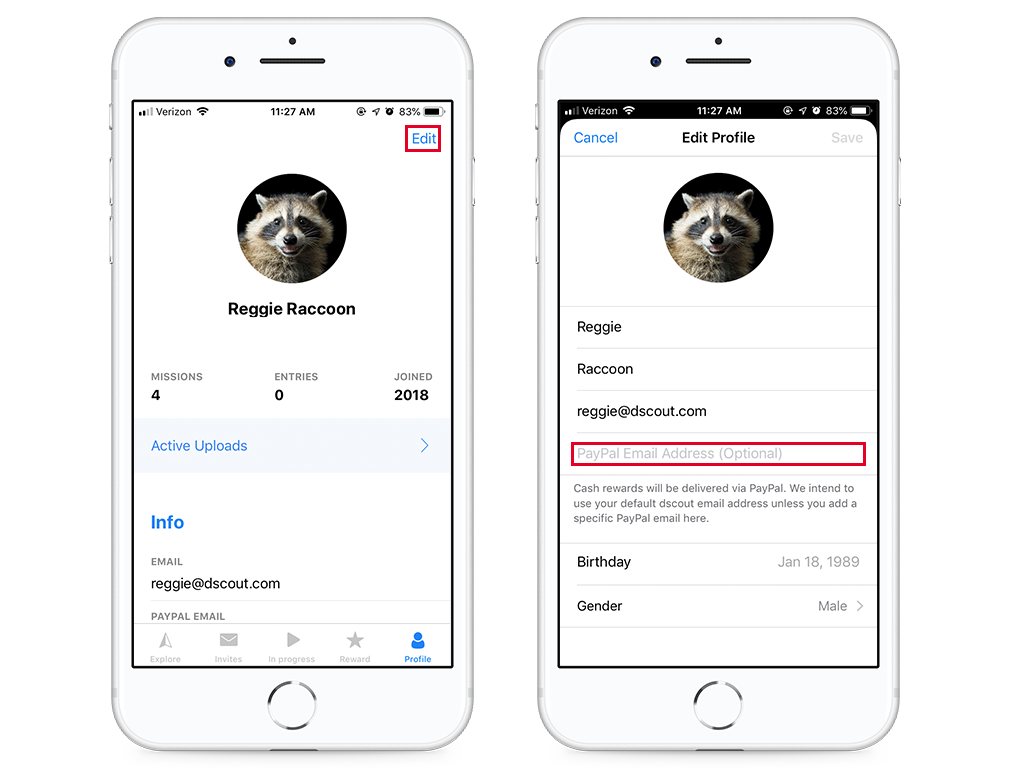
To add your PayPal email address in your Dscout profile on an iOS device, follow the directions below:
1. Tap on the **Profile icon** on the bottom-right corner of your screen’s navigation bar.
2. Tap on the **Edit button** on the top-right corner of your screen.
3. Add your PayPal email address in the field **PayPal Email Address**.
4. Tap the **Save button** on the top-right corner of your screen. Once updated, all future payments will be sent to your PayPal email address as opposed to the email address you use for Dscout.
## Adding your PayPal email address on iOS
To add your PayPal email address in your Dscout profile on an iOS device, follow the directions below:
1. Tap on the **Profile icon** on the bottom-right corner of your screen’s navigation bar.
2. Tap on the **Edit button** on the top-right corner of your screen.
3. Add your PayPal email address in the field **PayPal Email Address**.
4. Tap the **Save button** on the top-right corner of your screen. Once updated, all future payments will be sent to your PayPal email address as opposed to the email address you use for Dscout.
 ## Adding your PayPal email address on the web
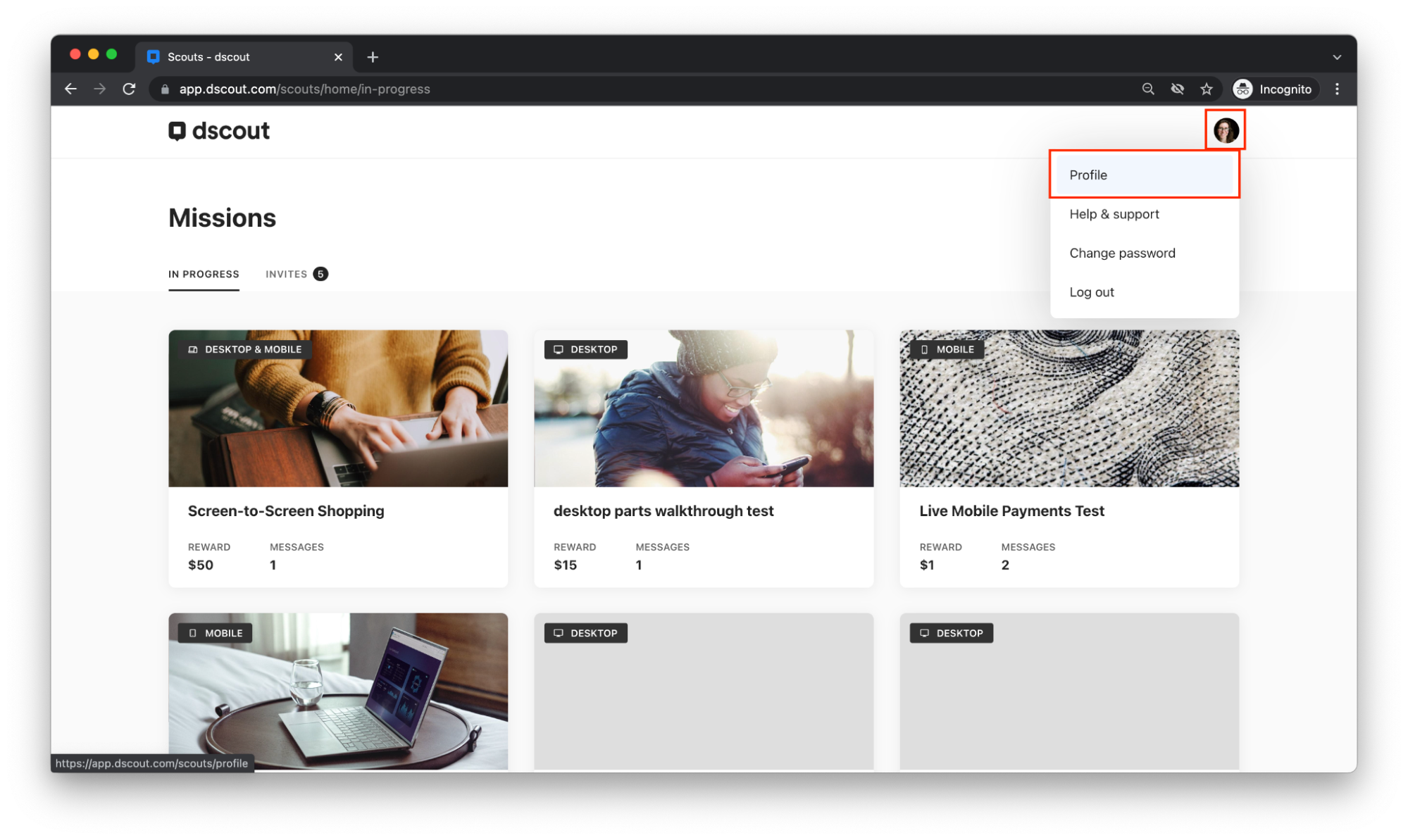
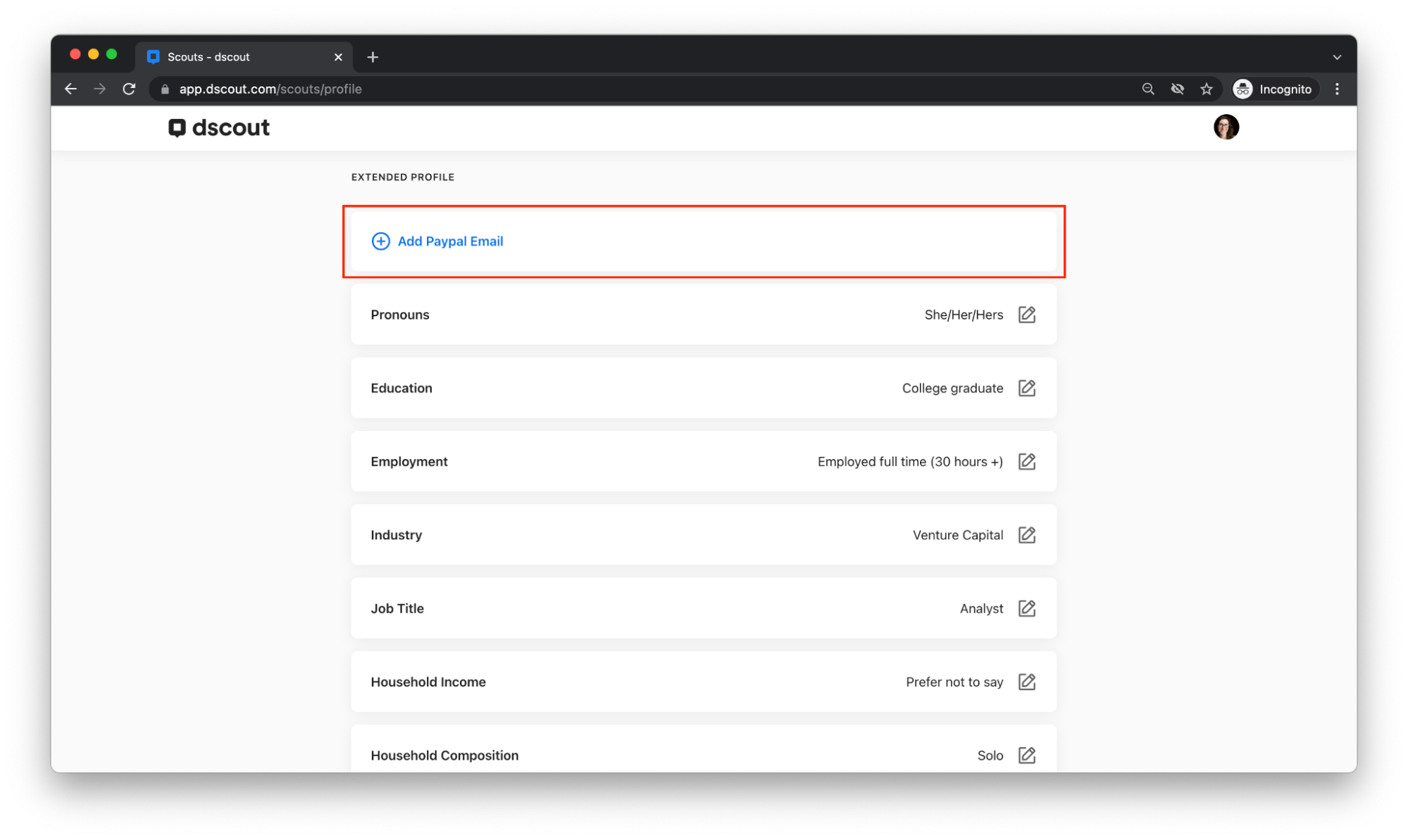
To add your PayPal email address in your Dscout profile on the web, follow the directions below:
1. Login to your Dscout account on the web at
2. Click on the **Profile photo** in the top-right corner of your screen’s navigation bar.
3. Click on the **Profile button** in the dropdown list in the top-right corner of your screen.
4. Add your PayPal email address in the field **PayPal Email Address** in the **Extended Profile** section.
5. Click the **Save button** in the PayPal Email Address modal. Once updated, all future payments will be sent to your PayPal email address as opposed to the email address you use for Dscout.
## Adding your PayPal email address on the web
To add your PayPal email address in your Dscout profile on the web, follow the directions below:
1. Login to your Dscout account on the web at
2. Click on the **Profile photo** in the top-right corner of your screen’s navigation bar.
3. Click on the **Profile button** in the dropdown list in the top-right corner of your screen.
4. Add your PayPal email address in the field **PayPal Email Address** in the **Extended Profile** section.
5. Click the **Save button** in the PayPal Email Address modal. Once updated, all future payments will be sent to your PayPal email address as opposed to the email address you use for Dscout.
 ---
# Agent Instructions
This documentation is published with GitBook. GitBook is the documentation platform designed so that both humans and AI agents can read, navigate, and reason over technical content effectively. Learn more at gitbook.com.
## Querying This Documentation
If you need additional information that is not directly available in this page, you can query the documentation dynamically by asking a question.
Perform an HTTP GET request on the current page URL with the `ask` query parameter, and the optional `goal` query parameter:
```
GET https://participanthelp.dscout.com/getting-paid/getting-paid-via-paypal/how-to-add-your-paypal-email-address-to-your-dscout-account.md?ask=&goal=
```
`ask` is the immediate question: it should be specific, self-contained, and written in natural language.
`goal` is optional and describes the broader end goal you are ultimately trying to accomplish on behalf of the user. GitBook uses it to tailor the answer towards what is most useful for that goal.
The response will contain a direct answer to the question and relevant excerpts and sources from the documentation.
Use this mechanism when the answer is not explicitly present in the current page, you need clarification or additional context, or you want to retrieve related documentation sections.
---
# Agent Instructions
This documentation is published with GitBook. GitBook is the documentation platform designed so that both humans and AI agents can read, navigate, and reason over technical content effectively. Learn more at gitbook.com.
## Querying This Documentation
If you need additional information that is not directly available in this page, you can query the documentation dynamically by asking a question.
Perform an HTTP GET request on the current page URL with the `ask` query parameter, and the optional `goal` query parameter:
```
GET https://participanthelp.dscout.com/getting-paid/getting-paid-via-paypal/how-to-add-your-paypal-email-address-to-your-dscout-account.md?ask=&goal=
```
`ask` is the immediate question: it should be specific, self-contained, and written in natural language.
`goal` is optional and describes the broader end goal you are ultimately trying to accomplish on behalf of the user. GitBook uses it to tailor the answer towards what is most useful for that goal.
The response will contain a direct answer to the question and relevant excerpts and sources from the documentation.
Use this mechanism when the answer is not explicitly present in the current page, you need clarification or additional context, or you want to retrieve related documentation sections.